

Bonvista Financial Services Pvt. Ltd. is an AMFI registered Mutual Fund Distributor holding ARN No.136656
Bonvista Financial Services Pvt. Ltd.
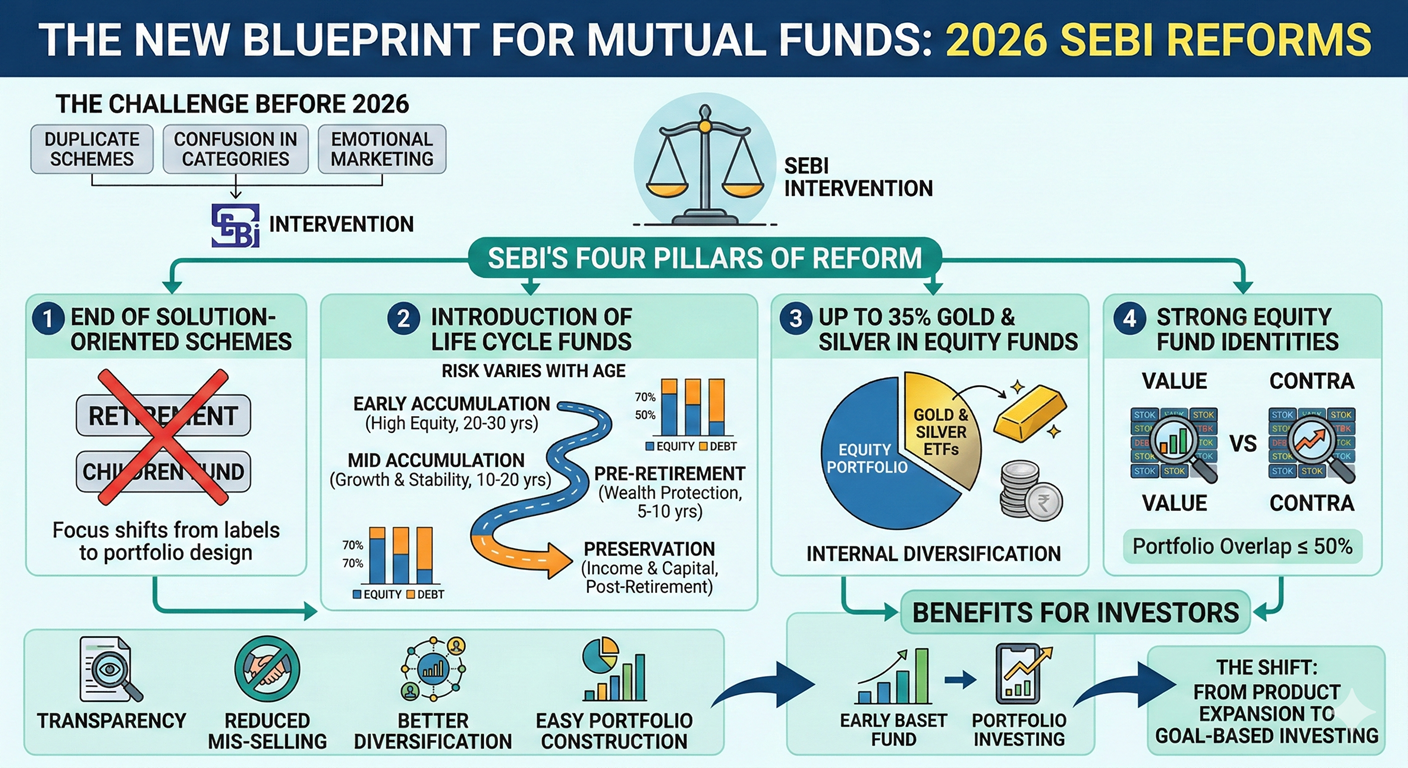
To many investors, mutual funds seem simple: pick a fund, start a SIP, and let compounding do its job. However, behind the scenes, the Indian mutual fund industry has faced an identity crisis: too many duplicate schemes, overlapping holdings, and superficial labels.
Over the past decade, funds across different categories began holding nearly identical portfolios. A large-cap fund, a flexi-cap fund, and a value fund from the same fund house often held the same 25 blue-chip stocks. Meanwhile, retirement and children's funds were marketed as customized life solutions, yet functioned like standard hybrid portfolios with five-year lock-ins.
To fix these structural discrepancies, the Securities and Exchange Board of India (SEBI) introduced a comprehensive regulatory overhaul under the SEBI Mutual Fund Regulations 2026.
These reforms are not just minor portfolio adjustments. They represent a fundamental shift toward goal-based investing, mandatory true-to-label portfolios, and stronger retail investor safeguards.
Why SEBI Stepped In: The 3 Core Industry Problems
Mutual fund assets in India have surged to historic highs, with retail investors and systematic investment plans (SIPs) driving massive inflows. However, rapid growth exposed three critical flaws:
-
Scheme Duplication: Asset Management Companies (AMCs) launched multiple funds with different marketing narratives, despite holding near-identical underlying stocks.
-
Category Ambiguity: Overlapping holdings made it nearly impossible for investors to understand the difference between large-cap, flexi-cap, contra, and thematic funds.
-
Emotional Marketing: Funds labeled for "Retirement" or "Children's Future" created a false sense of security, leading many investors to assume their returns were guaranteed or risk-free.
SEBI's 2026 framework forces fund houses to build portfolios that strictly match their stated investment mandates rather than relying on creative marketing.
4 Major Changes Under the New SEBI Mutual Fund Framework
1. Discontinuation of Solution-Oriented Schemes
The solution-oriented category, which housed retirement funds and children's gift plans, has been officially discontinued.
While these schemes featured mandatory 5-year lock-ins and emotional branding, their portfolio construction was practically identical to standard aggressive hybrid or flexi-cap funds.
Under the new regulations:
-
AMCs can no longer market equity-linked schemes using emotional life-stage labels unless they feature an automatic asset-allocation mechanism.
-
Existing solution-oriented schemes will not be shut down abruptly; instead, they will be rationalized and merged into standard categories matching their true underlying asset mix.
2. Introduction of Life-Cycle Funds
To provide a genuine alternative to retirement funds, SEBI introduced Life-Cycle Funds (often called Target-Date Funds globally).
Unlike static retirement funds, Life-Cycle Funds feature an automated glide path. When an investor is young and decades away from their target year, the portfolio holds high equity exposure. As the target maturity date draws closer, the fund systematically reallocates toward debt and stable assets to protect accumulated capital.
| Life Stage | Target Horizon | Equity Allocation | Debt / Gold / Silver | Strategic Objective |
|---|---|---|---|---|
| Early Accumulation | 20 to 30 years | 80% to 100% | Very Low (0% to 20%) | Maximum capital growth |
| Mid Accumulation | 10 to 20 years | 65% to 80% | Moderate (20% to 35%) | Balanced growth with stability |
| Pre-Retirement | 5 to 10 years | 40% to 65% | High (35% to 60%) | Capital preservation and de-risking |
| Preservation Phase | Post-Retirement | 0% to 40% | Very High (60% to 100%) | Steady income and capital protection |
3. Up to 35% Allocation to Gold, Silver, and InvITs
In a significant move toward multi-asset efficiency, SEBI allows equity mutual funds to allocate up to 35% of their residual portfolio to alternative assets, including gold and silver ETFs, as well as Infrastructure Investment Trusts (InvITs).
Previously, when equity valuations stretched or market volatility surged, fund managers were forced to hold cash or low-yielding debt. This update allows equity funds to hold precious metals as an automatic domestic inflation hedge without losing their core classification.
4. Strict 50% Portfolio Overlap Cap for Value and Contra Funds
AMCs can continue running both Value Funds and Contra Funds, but with a strict condition: the portfolio overlap between the two schemes cannot exceed 50%.
-
A Value Fund must target fundamentally solid stocks trading below their intrinsic value.
-
A Contra Fund must focus on out-of-favor companies or sectors going against prevailing market sentiment.
If an AMC's Value and Contra funds share more than 50% of the same securities, the fund house must rebalance holdings to maintain genuine strategy uniqueness.
Crucial Investor Safeguards: The SEBI 20/25 Rule Explained
A foundational compliance standard that frequently confuses investors is the SEBI 20/25 Rule. Designed to protect retail investors from concentration risk and sudden fund liquidation shocks, this mandate enforces two strict rules:
-
Minimum 20 Investors: Every mutual fund scheme and individual plan must maintain at least 20 unique investors at all times.
-
Maximum 25% Holding: No single investor (individual or corporate entity) can hold more than 25% of the scheme's total corpus or AUM.
If a corporate investor or Ultra-HNI holds more than 25% of a scheme, a sudden exit could force the fund manager into distress sales, hurting small retail unit-holders. The 20/25 rule ensures that fund houses cannot run personalized portfolios disguised as public mutual funds.
Official Stance: Are Mutual Fund Returns Guaranteed?
Under SEBI regulations, mutual fund returns are never guaranteed or assured.
SEBI strictly prohibits AMCs, mutual fund distributors, and financial intermediaries from advertising or promising fixed returns on any equity, hybrid, or debt mutual fund scheme.
Key regulatory facts every investor must know:
-
Every mutual fund scheme is market-linked and carries capital risk.
-
Even closed-ended funds or Life-Cycle funds control asset allocation, not market outcomes.
-
Any marketing material, distributor pitch, or social media promotion that promises assured percentages on mutual funds violates SEBI advertising codes.
What These Changes Mean for Your Portfolio
For the average retail investor, SEBI's 2026 guidelines deliver three major advantages:
-
True-to-Label Transparency: The scheme name on your statement will accurately describe what the fund manager actually buys.
-
Protection Against Thematic Overlap: You will no longer accidentally buy three different funds from the same AMC that hold the identical 20 stocks.
-
Structured Goal Planning: The introduction of Life-Cycle Funds allows hands-off investors to automate retirement rebalancing without having to manually switch funds every few years.
Mutual funds remain one of India's most efficient wealth-building instruments. With SEBI enforcing portfolio transparency and stricter categorization, the focus firmly shifts from chasing past performance to building a disciplined, goal-aligned financial plan.
Frequently Asked Questions (FAQs)
Q1: What are the main SEBI mutual fund regulations introduced in 2026?
The 2026 framework focuses on discontinuing redundant solution-oriented funds, introducing Life-Cycle funds with automated glide paths, allowing equity funds up to 35% exposure in gold and silver ETFs, and enforcing a maximum 50% portfolio overlap cap between Value and Contra schemes.
Q2: What is the 20/25 rule in mutual funds?
The 20/25 rule is a mandatory SEBI guideline requiring every mutual fund scheme to have at least 20 distinct investors, with no individual investor holding more than 25% of the total assets under management (AUM). This prevents high-net-worth single investors from destabilizing a fund during large redemptions.
Q3: Can mutual funds offer guaranteed returns under SEBI guidelines?
No. SEBI regulations strictly prohibit mutual funds from offering guaranteed or assured returns. All mutual funds are subject to market risks, and NAVs fluctuate based on underlying security performance.
Q4: Will existing retirement and children's funds stop working?
Existing investments remain safe. However, AMCs will no longer accept fresh subscriptions under outdated solution-oriented structures. Schemes will either align with the new Life-Cycle fund criteria or merge into relevant hybrid and equity categories.
Connect With Our Wealth Experts
Ready to transition from reactive saving to strategic wealth creation? Let our certified team assist you with expert Portfolio Management Services (PMS), high-alpha AIF advisory, and comprehensive retirement planning.
-
Book a Consultation: Book a meeting with us for ultimate wealth creation
-
Call Us: +91 8390040100
-
Chat With Us: +91 8390040200
-
Visit Us: 506, Business Galaxy Building, Opp. Gokul Hotel, Beside Box Cricket, Kute Marg, Tidke Colony, Nashik, Maharashtra 422002
Follow for daily updates: WhatsApp | LinkedIn | YouTube | Instagram | Facebook | X | Pinterest
Disclaimer: This article is for educational and informational purposes only and does not constitute financial or investment advice. Investors should consult with their certified financial planner or wealth manager before making any investment decisions. Mutual fund and gold investments are subject to market risks.

Mr. Unmesh Deshmukh
Founder & Director, Bonvista Financial Services | AMFI ARN: 136656
With over 24 years of elite experience in the financial services industry, Unmesh is a seasoned investment expert. He acts with a strict fiduciary mindset, leveraging data-backed strategies to help individuals and families create sustainable, generational wealth.
Connect on LinkedIn



Disclaimer: Mutual Fund investments are subject to market risks, read all scheme related documents carefully.
Bonvista Financial Services Pvt. Ltd. is an AMFI-Registered Mutual Fund Distributor (ARN: 136656).