

Bonvista Financial Services Pvt. Ltd. is an AMFI registered Mutual Fund Distributor holding ARN No.136656
Bonvista Financial Services Pvt. Ltd.
Imagine opening your investment app one morning and seeing that the Nifty 50 or Sensex has fallen 7% from its recent high.
You start worrying: “Is this a stock market crash? Should I sell my investments?”
A few months later, the Indian market falls by 20%. Now, analysts and news channels are talking about an impending bear market.
Then, during an unexpected global crisis, stock prices lose a massive amount of value within just a few trading sessions. That is when the term “market crash” starts appearing everywhere.
But are all these market declines the same? Not exactly.
A market correction, a bear market, and a market crash are distinct ways of describing a drop in stock prices. For retail investors across Nashik, Pune, Maharashtra, as well as NRI investors building wealth in the Indian markets, understanding these differences is crucial to responding rationally rather than making fear-based financial mistakes.
What Is the Difference Between a Market Correction, Bear Market, and Crash?
While all three involve a drop in portfolio values, they differ in speed, magnitude, underlying causes, and psychological impact.
What Is a Market Correction?
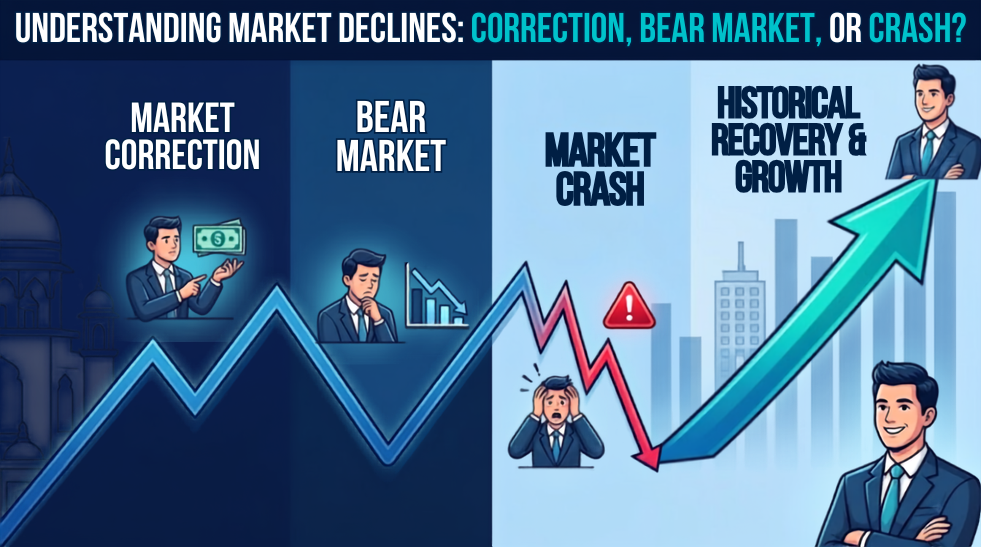
A market correction is generally defined as a decline of 10% or more from a recent peak in an index like the Nifty 50 or S&P BSE Sensex.
Think of it as the stock market taking a breath or a step back after moving up significantly over a period of time.
-
Example: Suppose the Nifty 50 rises from 20,000 to 24,000. Later, it falls to 21,600. That represents a 10% correction from its peak.
Corrections are a normal, healthy part of the long-term wealth creation journey. Markets never move upward in a straight line. After a strong rally, institutional investors (FIIs and DIIs) may book profits, market valuations may become expensive, interest rates
may rise, or short-term economic concerns may arise.
Should Investors Panic During a Correction?
Usually, no. A correction is healthy because it cools down excessive market optimism and brings valuations back to sustainable levels. A temporary correction does not mean there is a structural flaw in the Indian economy or in the fundamental strength of the companies you own.
What Is a Bear Market?
A bear market is generally defined as a prolonged decline of 20% or more from recent market highs.
-
Example: If an index drops from 25,000 to 20,000, the total fall is 20%, qualifying it as a bear market decline.
However, a bear market is more than just a specific percentage. It is accompanied by widespread pessimism, slowing economic growth, falling corporate earnings, tighter credit conditions, or significant global economic shocks.
During a bear market in Indian equities, negative sentiment dominates headlines:
-
"Economic growth is slowing down."
-
"Corporate profit margins are shrinking."
-
"Markets could drop another 10% to 15%."
This persistent negative feedback loop can create downward pressure on stock prices for months or even years.
Should Investors Panic During a Bear Market?
Not necessarily. While bear markets can feel painful and test your emotional discipline, they are a natural phase of the long-term economic cycle. For long-term investors in places like Nashik, Pune, and across India, the critical question is not:
"How much has my portfolio fallen today?" but rather: "Has the fundamental, long-term growth story of my investments changed?"
What Is a Stock Market Crash?
A market crash is vastly different in speed and sentiment. Unlike corrections or bear markets, there is no single percentage figure that officially defines a crash.
Instead, a market crash describes an extremely sharp, rapid, and sudden collapse in stock prices, driven by extreme fear, panic selling, or an unexpected black swan event.
A prime example is the COVID-19 market crash in March 2020. The Nifty 50 and Sensex plummeted dramatically within a few short weeks as global markets reacted to unprecedented uncertainty surrounding global lockdowns.
Join the "Paise Ki Paathshala" Community!
Navigating market volatility without experienced guidance can lead to costly emotional mistakes. Join our exclusive WhatsApp community Paise Ki Paathshala—managed by the wealth management team at Bonvista Financial Services.
Get regular market updates, sensible wealth insights, and rational portfolio guidance sent straight to your phone!
Comparison Table: Correction vs. Bear Market vs. Crash
| Feature | Market Correction | Bear Market | Market Crash |
|---|---|---|---|
| Typical Decline | Approx. 10%+ | Approx. 20%+ | Sharp, rapid fall |
| Speed | Usually gradual | Develops over months | Often extremely fast |
| Investor Sentiment | Caution | Pessimism | Fear / Panic |
| Duration | Short to moderate | Months to years | Initial drop is rapid |
| Common Trigger | Valuations / Profit booking | Economic weakness | Crisis / Unexpected shock |
| Recommended Action | Stay calm | Review portfolio | Avoid panic decisions |
Why Do Stock Markets Fall?
There is rarely a single reason for a market decline. In the context of Indian and global markets, equity prices can fall due to:
-
Rising interest rates by central banks (RBI, US Federal Reserve)
-
High inflation eating into consumer purchasing power
-
Weak corporate earnings or reduced forward guidance
-
Domestic or global economic slowdowns
-
Geopolitical tensions and supply chain disruptions
-
Overstretched market valuations
-
Heavy Foreign Institutional Investor (FII) selling
-
Currency weakness (e.g., Depreciation of the Indian Rupee)
-
Black Swan events (e.g., Pandemics, sudden policy shifts)
When several of these factors overlap, market declines become more pronounced.
The Most Important Lesson: Equity Markets Historically Recover
One of the most important lessons from financial history is that major market drops have historically been followed by strong recoveries. While timing is uncertain and recovery is never guaranteed for every individual stock, broad market indices like the Nifty 50 have consistently broken new high ground over long-term horizons.
The problem is psychological: Investors remember the short-term pain of a market fall but forget the long-term wealth created afterward.
During a crash or a bear market, sensational media headlines can make it feel like the economy will never recover. But eventually, economic activity stabilizes, corporate profits rebound, and investor confidence returns.
What Should a Retail Investor Do During Market Volatility?
If the market drops 10% or 20%, avoid making impulsive decisions to sell off your entire portfolio. Instead, follow these structured steps:
-
Identify the Source of the Fall: Determine whether the decline is caused by short-term sentiment/profit booking or a permanent shift in fundamental economic factors.
-
Conduct a Portfolio Health Check: Review your asset allocation. Ensure your wealth is spread across diversified asset classes (Equities, Debt, Mutual Funds, SIFs, and Fixed Income).
-
Focus on Quality: If you own well-managed companies or curated mutual funds with strong balance sheets, a temporary market drop does not destroy their long-term compounding capability.
Why Panic Selling Is the Single Biggest Investor Mistake
Imagine you invest 鈧�1,00,000 and a market correction reduces your portfolio value to 鈧�80,000. Overcome by anxiety, you sell everything to "stop further losses."
Six months later, the market recovers and climbs to new highs. But your capital is stuck in cash because you were waiting for the "perfect time" to get back in.
Investors rarely lose permanent capital simply because the market fell—they lose capital because panic selling locks in temporary paper losses and strips them of the recovery phase.
A Word of Caution on "Buying the Dip": While staying invested is vital, blindly buying every falling stock can also be a mistake. A 20% drop does not automatically make an overvalued, low-quality stock cheap. Always evaluate fundamental quality before deploying additional capital.
Final Investor Takeaway
Market volatility is the price of admission for long-term equity compounding.
The goal for retail investors in Nashik, Pune, and across the country is not to predict when the next correction or crash will happen. Instead, focus on building a resilient investment framework:
-
Maintain a dedicated emergency fund (6–12 months of expenses).
-
Maintain a diversified asset allocation tailored to your risk profile.
-
Avoid taking on excessive leverage or debt to invest in equities.
-
Align every rupee with a specific long-term financial goal.
-
Seek professional guidance rather than reacting to short-term market noise.
A falling market ultimately tests two things: your portfolio structure and your emotional behavior. Investors who understand the difference between a correction, a bear market, and a crash are equipped to navigate volatility calmly and compound wealth over time.
Connect With Our Wealth Experts
Ready to transition from reactive saving to strategic wealth creation? Let our certified team assist you with expert Portfolio Management Services (PMS), high-alpha AIF advisory, and comprehensive retirement planning.
-
Book a Consultation: Book a meeting with us for ultimate wealth creation
-
Call Us: +91 8390040100
-
Chat With Us: +91 8390040200
-
Visit Us: 506, Business Galaxy Building, Opp. Gokul Hotel, Beside Box Cricket, Kute Marg, Tidke Colony, Nashik, Maharashtra 422002
Follow for daily updates: WhatsApp | LinkedIn | YouTube | Instagram | Facebook | X | Pinterest
Disclaimer: This article is for educational and informational purposes only and does not constitute financial or investment advice. Investors should consult with their certified financial planner or wealth manager before making any investment decisions. Mutual fund and gold investments are subject to market risks.

Mr. Unmesh Deshmukh
Founder & Director, Bonvista Financial Services | AMFI ARN: 136656
With over 24 years of elite experience in the financial services industry, Unmesh is a seasoned investment expert. He acts with a strict fiduciary mindset, leveraging data-backed strategies to help individuals and families create sustainable, generational wealth.
Connect on LinkedIn




Disclaimer: Mutual Fund investments are subject to market risks, read all scheme related documents carefully.
Bonvista Financial Services Pvt. Ltd. is an AMFI-Registered Mutual Fund Distributor (ARN: 136656).